











Walk onto any active UAE construction site and you will likely see both machines in operation, but rarely doing the same job. Plate compactors and tamping rammers solve different problems, and contractors who treat them as interchangeable end up either under-compacting their fill or wasting expensive machine-hours on the wrong task.
This guide breaks down the technical difference between the two compaction methods, walks through the specific applications each is built for, and identifies which models from the Batmatic range, supplied across the UAE by Al Wisam Trading, match the conditions on a typical UAE site.
The Fundamental Difference: Pressure vs Impact
Plate compactors and tamping rammers achieve compaction by different physical mechanisms, and that difference dictates where each one performs best.
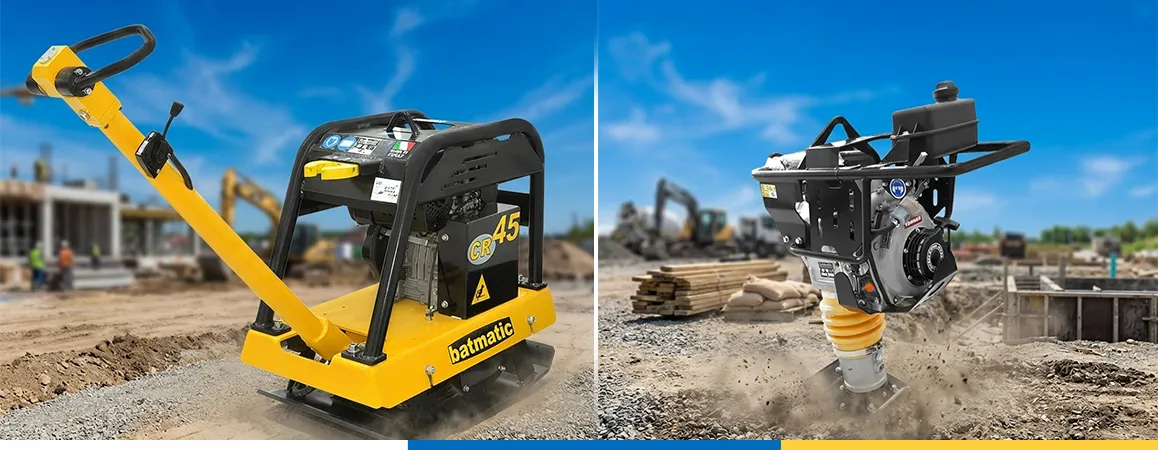
A plate compactor uses centrifugal force generated by a rotating eccentric weight to push a flat steel plate into the ground. The plate transfers compaction energy across its full surface area in rapid, low-amplitude impacts, typically 70 to 90 Hz. This is highly effective on granular materials: sand, gravel, sub-base aggregate, asphalt. The energy distributes laterally as well as downward, so plate compactors are the right choice for broad, open areas.
A tamping rammer is fundamentally different. It strikes the ground in high-amplitude vertical impacts, typically 11 to 18 kilonewtons of impact force, at around 600 to 700 blows per minute. The energy is concentrated in a small footprint and drives deep into cohesive soils, clay, silty fills, and the kind of dense back-filling that surrounds trench utilities. A rammer compacts a much narrower band of ground but penetrates it more deeply than a plate.
When to Specify a Plate Compactor
Plate compactors are the right answer when the ground to be compacted is granular, the working area is open, and surface uniformity matters more than vertical penetration depth. Typical UAE applications include:
- Sub-base preparation for slab pours and road construction
- Asphalt repair, patching, and interlock paving installation
- Backfill compaction in open excavations (not narrow trenches)
- Landscape and hardstanding preparation
- Foundation pads for villas and light commercial buildings
Forward vs Reversible Plates, A Critical Choice
Within plate compactors, there is a further subdivision that determines what jobs the machine can take on:
Forward plate compactors move in one direction only. They are lighter (typically 70 to 90 kg), easier to maneuver on small jobs, and well-suited to asphalt repair and pavement maintenance. For light compacting jobs and green-area preparation in the 65-116 kg weight class, these are the workhorses.
Reversible plate compactors move forward and backward under hydraulic control. They are heavier, anywhere from 190 kg in the CR3050 class to 680 kg in the CR9075, and they produce significantly more centrifugal force. The reversible action saves time on tight job zones where a forward-only plate would need to be physically turned around at every pass.
The Batmatic CR Range, What Al Wisam Carries
Al Wisam supplies the full Batmatic reversible plate compactor range, manufactured in Italy since 1971. The CR-series covers the spectrum from light reversible plates (CR3050) up to the heaviest, most powerful machine in the range (CR9075).
| Model | Working Width | Centrifugal Force | Best Suited For |
|---|---|---|---|
| CR 3050 | 500 mm | 30 kN | Asphalt maintenance, paving tile, trenches |
| CR 4550 | 500 mm | 45 kN | Foundations, sub-base, small/medium areas |
| CR 5570 / CR 5570-AE | Heavy duty | 55+ kN | Medium-sized deep compaction work |
| CR 9075 | Heavy duty | 90 kN | Deep compaction of large areas, foundations, excavations |
The flagship Batmatic CR9075 is worth specific attention: at 680 kg operating weight, 90 kN of centrifugal force, and powered by a twin-cylinder Kohler engine, it is the heaviest and most powerful reversible vibratory plate in the range. Its hydraulic system allows the operator to control directional speed and concentrate energy on areas requiring additional compaction, invaluable on UAE infrastructure projects where backfill must achieve specific density readings under municipality inspection.
When to Specify a Tamping Rammer
If you are compacting a narrow trench, working around live utilities, dealing with cohesive clay-rich soils, or backfilling against a vertical retaining structure, a plate compactor is the wrong tool. This is rammer territory.
Tamping rammers concentrate compaction energy into a narrow footprint, typically a 280 × 330 mm shoe, and strike vertically with enough force to penetrate cohesive backfill that would deflect a plate. Their compact dimensions allow them to operate in trenches as narrow as 400 mm, which makes them indispensable on utilities, gas pipelines, and water main installations across UAE infrastructure projects.
The Batmatic CV-Series
Al Wisam carries the Batmatic CV70H and CV80Y tamping rammers. Both deliver 16 kN of impact force at approximately 700 vibrations per minute, with a 60-70 cm working stroke and 15-18 m/min travel speed. Both handle slopes up to 20°.
Two design details set the Batmatic CV-series apart for UAE conditions. First, the range features high-efficiency air filtration, specifically engineered to protect the engine against the dust loadings typical of Sharjah and Abu Dhabi infrastructure sites. Second, the shoe geometry is optimised for cohesive soils, which matters because the alluvial fills common in coastal UAE projects tend toward higher clay content than typical European specifications assume.
Side-by-Side Comparison
| Factor | Plate Compactor | Tamping Rammer |
|---|---|---|
| Compaction mechanism | Centrifugal force, low amplitude | Vertical impact, high amplitude |
| Best soil type | Granular (sand, gravel, aggregate) | Cohesive (clay, silty fills) |
| Best area type | Open, broad, flat | Narrow, trenches, around utilities |
| Typical weight class | 70 kg (forward) to 680 kg (CR9075) | 65–85 kg |
| Frequency / impact rate | 70–90 Hz | 600–700 blows/min |
| Force output | 13–90 kN centrifugal | 13–18 kN impact |
| Use on asphalt | Yes (excellent) | No (excessive impact damages surface) |
| Use in narrow trenches | No (too wide) | Yes (purpose-built) |
The Real Answer: Most UAE Contractors Need Both
The plate compactor vs tamping rammer framing makes for a clean blog headline, but the practical truth is that most active UAE construction sites need both types of machine in rotation. A typical road construction project will use forward plate compactors for asphalt patching, reversible plates for sub-base compaction in the open carriageway, and tamping rammers for the trenches that run beneath the road for drainage, fibre, and water lines.
A well-equipped contractor maintains the smaller Batmatic FP-series for asphalt repair, at least one CR-series reversible plate in the 45-90 kN class for backfill and sub-base, and CV-series rammers for any work involving trenches or cohesive soils. The right strategy is to size each category to your typical project profile rather than over-investing in any single class.