











Large-format porcelain tiles are now standard in UAE luxury projects. Villa bathrooms specify 600×1200mm as a minimum. Hotel lobbies run 1200×2400mm across thousands of square meters. Some projects now use slabs up to 3,200mm in length. These are not tiles in the traditional sense. They are slabs, and they require completely different tools for cutting, handling, and installation.
Three problems separate large-format work from standard tiling. Cutting length: most tile saws stop at 700mm.
Fragility: A slab this size snaps during a poorly supported cut.
Bond coverage: You cannot press 80 kg of porcelain evenly by hand.
Each problem has a specific solution. This guide covers the Battipav tools available through Al Wisam Trading that solve each one.
What Is Considered Large Format and Why Does It Change How You Work?
The tile industry generally defines large format as anything above 60cm in the shortest dimension. In UAE fit-out, 600×1200mm is now routine. Sizes of 800×1600mm and 1200×2400mm are appearing on hospitality and high-end residential projects.
A 1200×2400mm porcelain slab weighs over 70 kg and covers nearly 3 m². That single piece is a structural and logistical challenge before it is an installation task. One person cannot safely carry it. One person cannot press it evenly into adhesive. And no 700mm tile saw can cut it.
The UAE luxury property market is driving this. Developers and interior designers specify large format because it creates expansive, seamless surfaces with fewer grout lines. That look is achievable. But it requires the right equipment at every stage, cutting, handling, and bonding.
Which Saw Do You Use to Cut Tiles Longer Than 700mm?
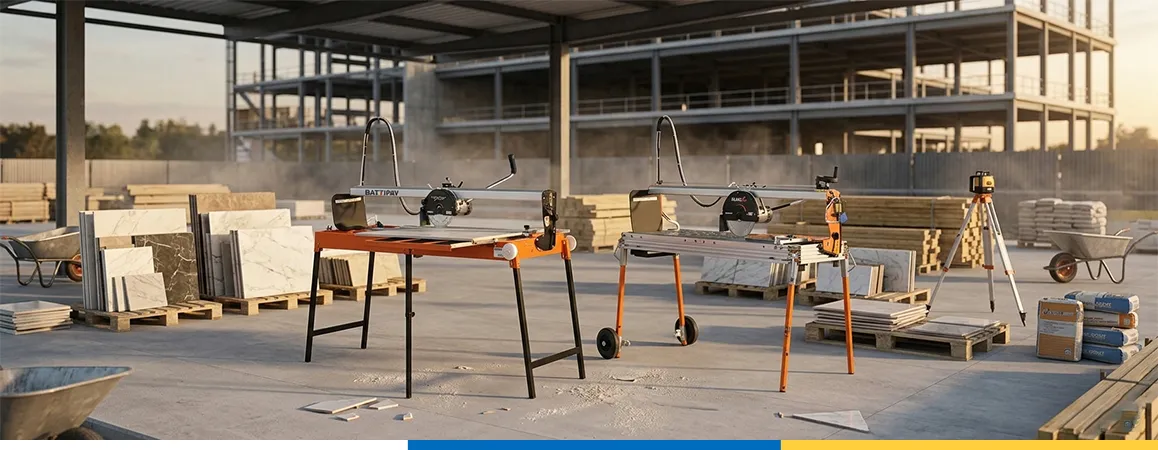
The Battipav Extra Superlunga 3300S is the answer for UAE crews working with large format porcelain. The cutting rail travels 3,300mm, enough to handle the full length of the largest formats currently in use on UAE projects. The machine cuts straight and 45° angles. The water-cooled diamond blade keeps the cut face clean through thick porcelain.
This matters because cut quality on large format porcelain is unforgiving. A rough cut on a 600×600mm tile is a five-minute repair. A rough cut on a 1200×2400mm slab is a wasted piece worth AED 800 or more, a delay, and a material reorder. The 3300S produces a clean edge every time because the slab is fully supported on the table and the head moves along a precision rail. The slab does not move. The cut does not drift.
The Battipav VIP 2125 is the alternative for mid-size large format work. It handles 2,125mm cutting length with straight and 45° cuts. For crews switching between 600×1200mm and 800×1600mm tiles during the day, the VIP 2125 is faster to set up than the 3300S and handles both formats. Both machines are available through Al Wisam.
How Do You Guarantee Full Adhesive Bond Under a Large Format Tile?
You cannot achieve full bond by hand. A tile above 600mm in any dimension cannot be pressed evenly across its entire surface by a person. Some areas will not make contact with the adhesive. The bond failure shows up as a hollow spot when knocked, and hollow means cracked under repeated foot traffic, loaded equipment, or thermal movement.
On UAE luxury projects, hollow tiles are a contractual defect. The fix involves breaking out the tile, removing the adhesive bed, and relay, which means replacing expensive material, paying rework labor, and disrupting the handover schedule. It is avoidable.
The Battipav PULSE solves this. It is a battery-powered professional vibrator designed specifically for large format tile and slab installation. After setting the tile on the adhesive bed, the operator applies the PULSE across the surface. The vibration moves air out of the adhesive and settles the tile into full contact with the bed. Bond coverage reaches the 95%+ that large format specifications require. No cable to manage across a busy fit-out floor. Available through Al Wisam Trading.
When Does a Manual Tile Cutter Work Better Than a Powered Saw?
Not every cut on a large format site needs a 3300S. Where standard ceramic tiles, 300×600mm, 600×600mm, or similar, run alongside large format in adjacent areas, a manual cutter is faster. It needs no water, no power, no setup time. Score and snap in under ten seconds.
The Battipav PROFI EVO 133 handles tiles up to 1,330mm on a manual score-and-snap cut. It is the right tool for larger ceramic formats that do not require the precision water-fed cut. The PROFI EVO 88 covers tiles up to 880mm. The LEGGERA is the compact daily-carry manual cutter for smaller formats.
Understand the material. Manual cutters work on ceramic, fired, brittle, score-and-snap. They do not work on thick porcelain stoneware or natural stone above a certain size. For anything that needs a water-fed diamond cut, use the powered saw.
Which Diamond Blade Do You Use for Porcelain, Stone, and Ceramic?
The Battipav TNSP is the correct blade for natural stone, marble, and granite in wet cutting. It is designed for hard, abrasive material where the blade bond must resist rapid wear.
For mixed-material sites, where the crew cuts porcelain in the morning and natural stone in the afternoon, the Battipav UNS universal blade covers both. It does not deliver the specialist performance of the TNSP on pure stone, but it eliminates blade changes on sites working with multiple materials.
Never use a masonry or asphalt blade on porcelain or stone. The bond specification is wrong for the material. The blade wears through rapidly. The cut face is rough. On expensive UAE project material, the cost of a wrong blade is the blade price plus the wasted slab.
Al Wisam stocks Battipav TNSP, TNSB, and UNS diamond blades in Sharjah for fast replacement orders. Contact us to confirm the right blade for your material before procurement.
What Is the Most Expensive Mistake on a Large Format UAE Site?
The most expensive mistake is cutting large format porcelain on a saw that was not designed for it. A 700mm saw with a 1200mm slab overhanging the table vibrates during the cut. The cut wanders. The slab fractures. The material is gone.
The second most expensive mistake is skipping the vibrator during installation. On a UAE project where tiles cost AED 300–1,000 per m², a hollow spot is a defect. The PULSE prevents it. The PULSE costs a fraction of one rework callback.
The third mistake is using generic blades. A cheaper blade on large format porcelain burns through in days and leaves rough cut faces. The Battipav blade lasts longer and cuts cleaner. The saving on the cheaper blade disappears in the first replacement cycle.