











Why Your Plate Compactor Keeps Failing on UAE Soil (And the Right Machine to Fix It)
You run the plate compactor over the fill. The surface looks tight. You move on. Two weeks later, the slab has settled, the paving has cracked, or the density test has come back below spec , and nobody can explain why the compactor did not do the job.
Here is the explanation: in most of these cases, the plate compactor UAE contractors are using is perfectly functional. It is just the wrong machine for the soil underneath it. UAE soil conditions are genuinely different from the conditions plate compactors are typically designed and tested for, and that mismatch is one of the most common and least discussed causes of compaction failure on sites across Dubai, Sharjah, Abu Dhabi, and the wider region.
This guide covers exactly why that happens, what UAE soil actually does to standard compaction equipment, and which Batmatic compactor configurations Al Wisam recommends based on the material and project type.
UAE Soil Is Not What Most Compaction Equipment Is Designed For
Most plate compactors, and most compaction guidelines, are developed for markets where granular soils with predictable particle size distributions are the norm. Gravel, crushed stone, and well-graded sandy soils compact efficiently under vibration because the particles interlock and lock into place under repeated passes.
UAE soil is more complicated. Across different emirates and project locations, contractors encounter several distinct soil challenges that defeat standard plate compaction:
Aeolian (Wind-Blown) Desert Sand
Much of the UAE's surface soil is aeolian sand , fine, uniform, poorly graded grains deposited by wind over thousands of years. Under a vibratory plate, this sand does not interlock the way well-graded granular fill does. Instead, the vibration causes the fine particles to rearrange temporarily during compaction but rebound as soon as the machine moves on. You get surface densification without structural improvement below , and the soil compaction UAE contractors think they have achieved is not there.
Hydraulic Fill on Reclaimed Land
Large areas of Dubai, particularly in coastal and waterfront developments, sit on reclaimed land built from dredged marine sand. This hydraulic fill is saturated and loosely structured when placed. Without deep vibro-compaction treatment, the upper layers may appear to compact under a plate but remain susceptible to long-term settlement as the deeper material continues to consolidate under load. A plate compactor operating at the surface cannot reach or address what is happening several meters below.
Mixed Cohesive and Granular Fills
On construction sites where cut and fill earthworks are involved, particularly in areas around Sharjah's industrial zones, Abu Dhabi's suburban expansions, and the northern emirates, contractors frequently encounter mixed soils that combine silty or clayey fines with granular material. This is the most problematic type for plate compactors.
Granular materials need vibration to compact. Cohesive soils need impact force and kneading to compact. A standard forward plate compactor delivers vibration efficiently but provides minimal impact force. On a mixed soil, it compacts the granular component while leaving the cohesive fines uncompacted , and the result is a fill that passes a visual check but fails under load.
Sabkha (Salt Flat) Ground
In certain coastal areas and low-lying parts of the UAE, sabkha ground presents a different challenge entirely. This salt-rich, gypsiferous soil appears firm at the surface but has very low bearing capacity and changes behavior significantly with moisture. Compacting sabkha with a plate compactor without proper sub-grade investigation and treatment can create a compacted crust over a weak, unstable sub-base, exactly the kind of failure that appears fine at handover and develops into a problem months later.
The UAE Ministry of Infrastructure Development and various emirate-level authorities specify sub-grade investigation and compaction testing requirements for road and infrastructure projects precisely because UAE soil conditions are varied and often non-standard. Always check what sub-grade assessment has been done before selecting compaction equipment for a project.
Why a Standard Forward Plate Compactor Underperforms on These Soils
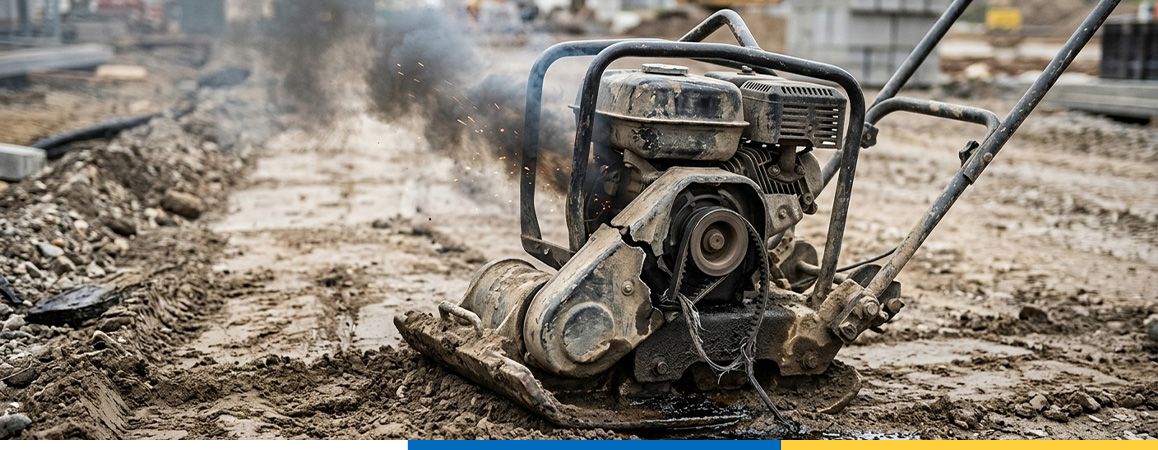
A forward plate compactor works by spinning an eccentric weight at high speed inside the machine's housing. This creates vibration that transfers through the base plate into the ground, causing granular soil particles to rearrange into a denser configuration. The machine travels in one direction, forward, making pass after pass to build up compaction density in layers.
This works very well for clean, well-graded granular fill: road base, crushed stone sub-base, and coarse sand fills respond exactly as expected. The problems arise when the soil type changes:
- On fine aeolian sand: The uniform particle size means vibration causes temporary densification that partially rebounds after the machine passes. Multiple passes help but often cannot achieve the target density in a single compaction phase without additional measures such as moisture conditioning or geotextile reinforcement of the sub-grade.
- On cohesive or mixed soils: Plate compactor vibration causes 'pumping' in cohesive material, the soil moves under the plate but does not densify. In severe cases, the machine's vibration actually disturbs the soil structure rather than improving it. A rammer or padfoot roller is the correct machine for these conditions.
- On thick fill layers: Forward plate compactors have a defined compaction depth. Placing fill in layers thicker than the machine's rated compaction depth leaves the lower portion of the layer uncompacted, regardless of how many passes are made at the surface. This is one of the most common causes of sub-surface settlement on UAE sites.
- In extreme heat: UAE summer temperatures affect machine performance. Overheating of engines and exciter units in underpowered or poorly maintained compactors causes reduced vibration output, which means reduced compaction even when the machine appears to be running normally.
How to Choose the Right Compactor Machine for Your UAE Project
The starting point is knowing what you are compacting, not just that you need to compact something. Here is a practical guide based on the soil types and application types commonly found on UAE construction sites:
Clean Granular Fill and Road Sub-Base: Forward Plate Compactor
When you are working with clean, well-graded granular material , crushed stone, road base aggregate, or coarse sandy fill , a forward plate compactor UAE contractors use is the right tool. The Batmatic FP series, available through Al Wisam, covers a range of plate widths and centrifugal force outputs suited to different layer thicknesses and project scales.
The Batmatic FP2150 is the most powerful model in Batmatic's forward plate series, delivering 21 kN of centrifugal force and available with either petrol or diesel engine. Its compact design and forward drive make it practical for trench backfill, sub-base compaction around structures, and paving preparation on sites across Dubai and Sharjah.
Mixed Cohesive-Granular Fill: Reversible Plate Compactor or Rammer
If your site investigation confirms cohesive fines content in the fill material , silts, clays, or a mixed profile , switch your equipment selection. A reversible plate compactor delivers higher centrifugal force and more operating weight per unit area than a standard forward plate, which improves performance on semi-cohesive materials.
The Batmatic CR5570 reversible plate compactor, also available through Al Wisam, delivers 55 kN of centrifugal force with an operating weight of approximately 410 kg. Its hydraulic directional control allows the operator to apply additional compaction effort to specific areas without repositioning, a significant advantage when working around foundations, pits, and confined fill zones.
For fills with significant clay content, a rammer (jumping jack compactor) is the appropriate choice. Al Wisam supplies rammers specifically for cohesive soil compaction in trench backfill and confined applications. [Internal Link: Rammers and Tampers UAE]
Asphalt Repair and Surface Compaction: Forward Plate with Water Tank
For compacting fresh asphalt patches, small paving areas, and surface reinstatement work on UAE road projects, a forward plate compactor fitted with a water tank is essential. The water system prevents the hot asphalt from sticking to the steel base plate. Without it, the machine picks up asphalt on the plate and deposits it unevenly across the surface, ruining the finish.
The Batmatic FP1342 W, fitted with a rollbar and water tank, is designed exactly for this application, making it a practical compactor machine Dubai road and paving teams use for asphalt maintenance and reinstatement work.
If your plate compactor is leaving a rippled or patterned surface finish on asphalt rather than a smooth one, the water system is either not working or running dry. Check the tank and pump before starting every asphalt compaction job.
Large Granular Sub-Base Areas: Walk-Behind Double Drum Roller
For larger areas of granular sub-base compaction where a plate compactor's productivity is too low for the project schedule, a walk-behind double drum roller delivers more coverage per shift with consistent compaction density across the width of the drum. Al Wisam supplies Batmatic walk-behind double drum rollers for these applications , used on car park sub-base, pathway construction, and medium-scale road works across the UAE. [Internal Link: Walk-Behind Double Drum Rollers UAE]
What Compaction Failure Actually Costs a UAE Contractor
Compaction failure is not just a technical inconvenience. On a UAE construction project, the downstream consequences are expensive and sometimes contractually significant:
- Failed density tests (proctor tests, plate load tests) require rework, stripping out the compacted layer and recompacting in controlled lifts adds cost and time to any project program.
- Settlement beneath floor slabs, pavements, and infrastructure causes cracking, ponding, and structural remediation that is far more expensive than correct compaction would have been.
- Road surface failure on UAE projects , potholes, rutting, and cracking at utility reinstatement points, frequently traces back to inadequate sub-base compaction at the backfill stage.
- Reputational impact: on projects where compaction records are maintained and inspected by supervising engineers or client representatives, documented failures create contractual exposure for the contractor.
Choosing the correct compactor for UAE soil conditions from the start is significantly less expensive than the cost of a single failed density test, rework cycle, or post-construction settlement claim.
Why Batmatic Compactors Work on UAE Job Sites
Batmatic is an Italian compaction equipment manufacturer with over 50 years of experience designing machines for professional construction and civil engineering use. Their equipment is engineered for sustained heavy-duty operation, which matters specifically in the UAE context for two reasons.
First, UAE construction schedules are demanding. Equipment that overheats, requires frequent maintenance interruptions, or delivers inconsistent output under sustained load costs project time. Batmatic's exciter units are zero-maintenance sealed systems, no greasing, no periodic adjustment, which reduces downtime on active UAE sites.
Second, the range covers the full spectrum of compaction requirements: from the lightweight FP1342 for asphalt repair and landscaping through to the heavy-duty CR5570 reversible unit for deep granular and semi-cohesive compaction. Contractors working across different UAE site conditions can specify the right Batmatic model for each application rather than compromising with a single machine across all soil types.
Al Wisam Trading Co. is the authorised Batmatic distributor in the UAE. Genuine Batmatic spare parts, technical documentation, and after-sales support are available through our Sharjah facility , which means that when a Batmatic compactor needs service on an active site in Dubai or Abu Dhabi, the support is local, not international.
The Straightforward Answer to Compaction Failure on UAE Sites
A plate compactor that keeps failing on UAE soil is almost never a broken machine. It is a correctly functioning machine being used on the wrong soil type, at the wrong layer thickness, or without adequate moisture conditioning. The UAE's soil profile, aeolian desert sand, hydraulic reclamation fill, mixed cohesive-granular fills, and occasional sabkha, does not behave the way the compaction equipment manual assumes it will.
The fix is matching the machine to the material. Forward plate compactors for clean granular fills. Reversible heavy-duty plates for mixed or semi-cohesive fills. Rammers for cohesive soils and confined trench backfill. Walk-behind rollers for larger granular areas. And in every case, controlled layer thicknesses and field density testing to confirm the result rather than assuming the machine has done the job.
Al Wisam Trading Co. supplies the full Batmatic compaction range across the UAE. If you are not sure which machine is right for your project's soil conditions, our technical team will review your site requirements and point you toward the correct equipment , not the most expensive one, the right one.