













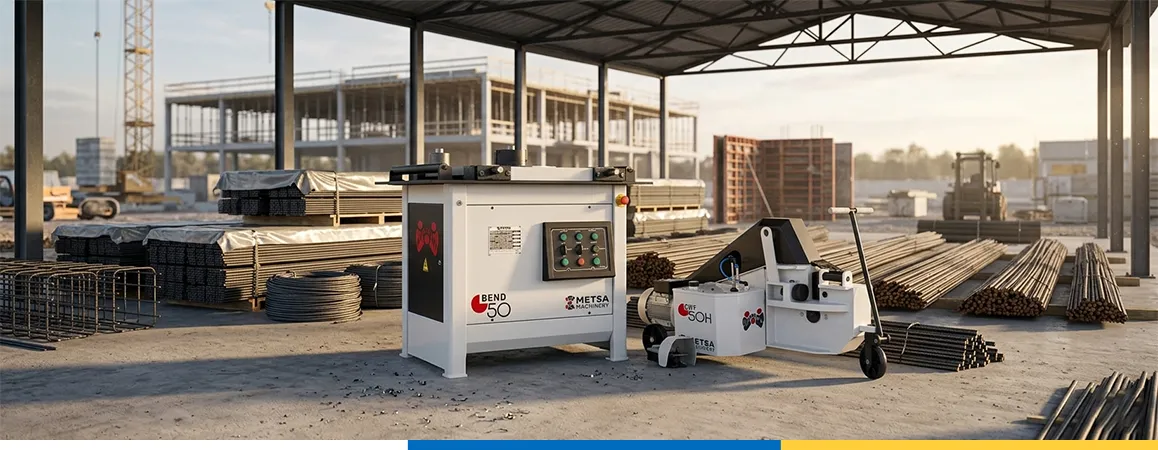
Every reinforced concrete structure in the UAE needs rebar. High-rise towers in Dubai, road bridges in Abu Dhabi, foundation slabs in Sharjah, every one of them requires steel bars cut to exact lengths and bent to precise angles. How your site processes that steel determines your speed, your material waste, and your labour cost per pour.
This guide covers how rebar machines work, what types are available, and how to choose the right configuration for UAE construction conditions.
What Is a Rebar Bending Machine?
A rebar bending machine shapes steel reinforcement bars to the angles specified in the structural drawing. The bar sits against a fixed bending point. A rotating pin or disc drives the bar around that point to produce the required angle, 90°, 135°, or any other geometry the drawing calls for. Most machines do this in under five seconds. Every bar comes out identical.
A rebar cutting machine cuts bars to length. A hydraulic or electric cutting head brings a hardened blade through the bar cross-section cleanly. The cut takes two to three seconds. The end is square, clean, and ready to place , no grinding, no dressing required.
Combined machines cut and bend in a single unit. The operator cuts the bar to length, then bends it without moving to a second station.
Why Is a Rebar Machine Faster Than Manual Methods?
On a UAE high-rise project, a reinforcement crew processes hundreds of bars per shift. Manual cutting , angle grinder or bolt cutter , is slow and physically demanding. It produces rough cut ends. Angle grinding generates heat at the cut face. Some UAE structural specifications prohibit heat cutting for this reason: heat changes the metallurgical properties of the bar end.
A hydraulic rebar cutter produces a clean cut in one stroke. No heat. No sparks. No metallurgical damage.
Manual bending, bending bars over a steel mandrel by hand, cannot reproduce the same angle twice on 200 consecutive bars. A machine can. Rebar cage accuracy depends on consistent bend geometry. Inaccurate bends mean adjusted bar spacing and rework at the placement stage.
What Types of Rebar Machine Are Available?
Rebar Bending Machines
The standard machine for repetitive bending work. Fixed to a workbench or floor. Handles bar diameters from 6mm to 40mm depending on the model. The most common machine on UAE high-rise reinforcement fabrication yards.
Rebar Cutting Machines
Standalone cutters for bar preparation and stockpiling. Hydraulic models can cut multiple bars simultaneously. The right choice for high-volume pre-cutting operations where a team pre-processes bar lengths before the bending phase starts.
Combined Cutting and Bending Machines
A single machine that cuts and bends in sequence. Right for sites where floor space is limited, or where a single operator manages both operations. The operator cuts to length, then bends without moving to a second station.
Portable Rebar Cutting and Bending Machines
Lightweight units that come to the bar, not the bar to the machine. Essential on UAE high-rise floors above ground level. Moving full-length bars from a ground-level cutting yard to upper floors requires crane time and deck space. Portable machines let the crew take pre-cut bundles to the floor and finish bending on the slab. Crane lifts move bundles, not bent shapes. The reinforcement crew does not wait for ground-level processing to catch up.
Spiral Bending Machines
A specialist machine for column and pile reinforcement. Spiral bending produces the continuous helix cage that wraps column main bars. This cannot be done manually at any production rate. The spiral bending machine forms the helix to the specified diameter, pitch, and length. Every column cage comes out identical.
Which Rebar Machine Is Right for a UAE High-Rise Project?
The answer depends on four variables.
◆ Bar diameter. Confirm the maximum bar diameter in the structural specification. The machine must handle it. Many standard machines handle 8–32mm. Projects with 36mm or 40mm main bars need a higher-capacity unit.
◆ Project type. Slabs and walls use repetitive bent shapes. A fixed bending machine running a single program handles these efficiently. Columns and piles with spiral cages need a spiral bender as a separate station.
◆ Floor level. Above the 20th floor, a portable machine is the productive choice. At ground level or on a large fabrication yard, a fixed machine with higher throughput is faster.
◆ Power supply. Most rebar machines run on 380–415V three-phase. Confirm site power before ordering.
What Happens When You Use the Wrong Rebar Machine?
Using a machine undersized for the bar diameter damages the bending disc and produces inaccurate angles. The disc deflects under load. The bar springs back beyond the target angle. Every bar needs individual adjustment. The time saving of the machine disappears.
Using a fixed machine on upper floors creates a logistics problem. Bent shapes are awkward to move. Long bars lifted by crane require slings, deck space, and crane time. A portable machine eliminates this by keeping bar in straight lengths until it reaches the work level.
What Should You Know About METSA Rebar Machines?
Al Wisam supplies METSA Machinery rebar cutting and bending equipment from our Sharjah facility. METSA has manufactured rebar processing machines since 1990. Their production facility uses CNC machines and robotic systems. Every machine frame and bending component goes through heat treatment , the process that prevents metal fatigue under the repeated high-load cycles a UAE site imposes across a long project program.
METSA exports to over 30 countries. Their range covers standalone benders, standalone cutters, combined machines, portable units, and spiral bending machines.
Contact Al Wisam to discuss your bar diameter, shift output target, and whether a fixed or portable configuration suits your site program. Our team confirms the right METSA specification before you commit to procurement.
Frequently Asked Questions
What rebar diameter capacity do I need for a typical UAE project?
Most building work uses bar up to 25 or 32 millimetres, so machines rated GW40/GQ40 class (40 millimetre capacity) carry comfortable headroom. Match the machine's rated capacity to the largest bar on your bending schedule with a margin, because running any machine at its limit all day shortens its life.
Do I need separate bending and cutting machines?
For steady production, yes: a dedicated cutter and a dedicated bender let two operators work in parallel and each machine is optimised for its job. Combined machines suit smaller yards where floor space and budget matter more than output.
Can rebar machines run on UAE site power?
Most production benders and cutters are three-phase machines, so they need a proper site supply or generator. Check the motor rating against your distribution board before delivery, not after.
What maintenance do rebar machines need in this climate?
Dust is the enemy: keep gearbox oil changed on schedule, blades and bending pins greased, and electrical cabinets sealed and blown out regularly. Blades and pins are consumables; keeping spares on the shelf prevents production stops.
Does Al Wisam stock blades and spares for rebar machines?
Yes. Cutting blades, bending pins and wear parts for the machines we supply are stocked in Sharjah with fast delivery across the Emirates.


