











On an industrial slab project, the difference between a contract paid in full and a contract held for rework usually comes down to a single number: the floor flatness tolerance. Achieving a specified F-number, whether it is ACI 117's FF50 for a warehouse floor or a tighter FF75 for a logistics distribution center, depends on equipment that most outsiders barely notice. The power trowel.
This guide walks through what UAE finishing contractors should look for when specifying a power trowel, the three machine sizes that cover most UAE site requirements, and the SIRL trowels supplied by Al Wisam Trading that have become the working specification on industrial floor projects across the UAE.
Why Power Trowels Matter More on UAE Slabs
Concrete finishing in the UAE has specific challenges that European or temperate-climate finishing crews do not face. Three in particular drive equipment choice:
Surface evaporation rate
UAE ambient temperatures regularly exceed 40°C, with relative humidity that can drop into the teens. The combined effect on a freshly poured slab is rapid surface evaporation, sometimes more than 1.0 kg per square meter per hour, well above the threshold where plastic shrinkage cracking becomes likely. This shortens the working window for floating and troweling.
The implication: equipment must be fast. A larger trowel that covers more area per pass, and a crew that operates it efficiently, is often the difference between a finished slab and a cracked one.
F-number specifications are tightening
UAE warehouse, logistics, and distribution center projects increasingly specify F-numbers that match or exceed European norms. A racking-grade floor in a high-bay warehouse may require FF45 minimum overall and FL35 within defined lanes. These tolerances are not achievable with hand floating alone, they require power trowel passes calibrated to the specific blade type, RPM, and pitch.
Concrete density and abrasion resistance
Modern industrial flooring in UAE distribution centers faces forklift abrasion, point loads from racking systems, and dust generation that wears the wearing course over time. Power trowel passes do more than smooth the surface, they densify it. A well-troweled slab has measurably higher surface density and abrasion resistance than one float-finished and left to cure.
The Three Power Trowel Sizes That Cover Most UAE Projects
Power trowels are categorized primarily by their working diameter , the diameter of the rotor or 'cage' that holds the trowel blades. Within walk-behind machines, three size classes cover most UAE site requirements:
Small walk-behind (600 mm class), for restricted areas
Small walk-behind trowels are the right choice for residential slabs, restricted-access commercial projects, narrow corridors, and edge-finishing work where larger machines cannot operate. They typically weigh around 60 kg, draw modest engine power, and are easily transported between job sites in a pickup.
Their limitation is coverage rate , for industrial slabs above approximately 200 m², the productivity loss compared with a larger trowel quickly outweighs the access advantage.
Medium walk-behind (900–1000 mm class), the versatile middle
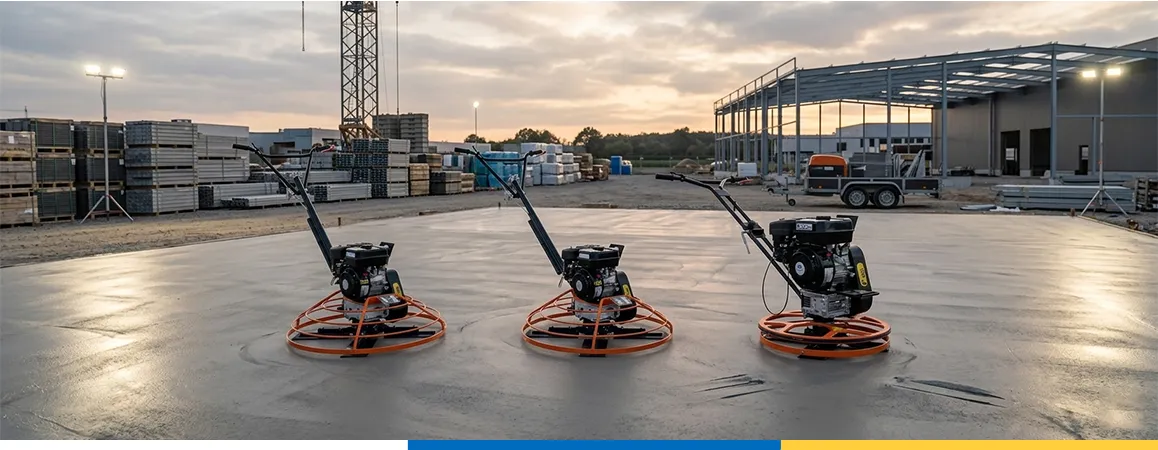
Medium walk-behind trowels are the most commonly specified size on UAE villa, light commercial, and small industrial slabs. The working diameter of around 900-1000 mm covers ground efficiently while remaining maneuverable around columns, drains, and pour edges. Crews typically run two operators in rotation on slabs above 500 m².
Large walk-behind (1100+ mm class), for industrial productivity
Large walk-behind trowels are the right specification when the slab is open, the area is significant, and the finishing window is tight. A 1135 mm trowel with adjustable blade pitch can complete one full pass on a 1000 m² slab in approximately two hours , fast enough to keep ahead of a typical UAE evaporation curve.
Above the 1100 mm class, the next step up is ride-on trowels , which Al Wisam can specify on request for very large industrial projects.
The SIRL Power Trowel Range , What Al Wisam Trading Carries
SIRL is the Portuguese manufacturer Al Wisam represents for power trowels in the UAE. The SIRL SH-series covers the walk-behind range with three primary models that fit the three size classes outlined above.
| Model | Diameter | Power | Weight | Best Application |
|---|---|---|---|---|
| SIRL SH 60 | 600 mm | 4.4 kW (electric) | 60 kg | Small areas, repair, edge work |
| SIRL SH 90 | Medium class | Petrol | Medium class | Villa slabs, light commercial pours |
| SIRL SH 120 | 1135 mm | 8.5 HP | 102 kg | Industrial slabs, warehouse floors, large pours |
SIRL SH 60, The Small-Area Specialist
The SH 60 is SIRL's compact electric trowel, a 600 mm working diameter, 4.4 kW power, 60 kg operating weight, with 230 × 120 mm blade size. Its blade position is adjustable, and it ships with an emergency stop peg and a built-in timer for shift-controlled finishing. The electric drive makes it the right choice for indoor pours and projects where exhaust emissions are restricted.
SIRL SH 90, The Versatile Middle
The SH 90 sits in SIRL's medium-class walk-behind range. It is the workhorse for the majority of UAE finishing crews , large enough to cover ground efficiently on villa slabs and light commercial pours, small enough to remain maneuverable around fixed obstacles.
SIRL SH 120, The Industrial Specification
The SH 120 is the heavy walk-behind specification. With 8.5 HP power, a 1135 mm total working diameter, 450 × 150 mm blade dimensions, and a 102 kg operating weight, it is sized for industrial slabs where coverage rate matters as much as finish quality. Standard features include an adjustable blade position, easily adjustable working height, emergency stop peg, and an integrated timer.
The SH 120 ships with trowel blades included, with trowel pan and finishing blades available as optional accessories. The trowel pan is essential for the first floating pass on a slab where bleeding water is still surfacing; the finishing blades produce the densified, glossy surface that defines a properly executed industrial pour.
Matching Trowel to Project Type
A simple decision framework for selecting between the three SIRL SH-series models:
- Residential slab, balcony, repair, or interior work , SIRL SH 60 (electric, compact, maneuverable)
- Villa or light commercial slab in the 100–500 m² range , SIRL SH 90 (medium class, versatile)
- Industrial slab, warehouse, distribution center, or any pour above 500 m² , SIRL SH 120 (large diameter, fast coverage)
- Multi-thousand square meter pours where ride-on equipment becomes economical , request a quote from Al Wisam's technical team
Common Mistakes UAE Finishing Crews Make
These errors recur often enough on UAE projects to be worth flagging here:
1. Starting the first pass too early. A trowel pan operated before the slab has finished bleeding pulls water back into the surface and weakens it. Wait until the surface can support a footprint that leaves an indentation of approximately 3-5 mm.
2. Running blades flat through every pass. Blade pitch should increase progressively across passes , flat for the first float, then incrementally angled for finishing passes. Failure to adjust pitch produces a flat but porous surface.
Frequently Asked Questions
What size power trowel do I need for a villa slab in the UAE?
For villa and light commercial slabs in the 100–500 m² range, a medium walk-behind trowel in the 900–1000 mm class, such as the SIRL SH 90, is the standard specification: large enough to cover ground efficiently, small enough to stay maneuverable around columns, drains, and pour edges.
Which power trowel is right for warehouse and industrial floors?
The SIRL SH 120 is the industrial specification: 8.5 HP, an 1135 mm working diameter, and a 102 kg operating weight. A trowel of this class can complete a full pass on a 1000 m² slab in roughly two hours, fast enough to stay ahead of a typical UAE evaporation curve on open pours above 500 m².
Is there an electric power trowel for indoor or emission-restricted pours?
Yes. The SIRL SH 60 is a compact electric trowel, 600 mm working diameter, 4.4 kW, 60 kg, suited to indoor pours, restricted-access areas, edge work, and projects where exhaust emissions are not permitted.
When should the first power trowel pass start?
Only after the slab has finished bleeding. A practical field test: the surface should support a footprint that leaves an indentation of approximately 3–5 mm. Starting earlier pulls bleed water back into the surface and weakens it.
Why do UAE slabs need faster troweling than slabs in cooler climates?
UAE ambient temperatures regularly exceed 40°C with very low humidity, driving surface evaporation above 1.0 kg per square meter per hour, past the threshold where plastic shrinkage cracking becomes likely. That shortens the working window, so coverage rate matters as much as finish quality.
Do power trowels only smooth the slab, or do they improve durability too?
Power trowel passes densify the surface as well as smooth it. A well-troweled slab has measurably higher surface density and abrasion resistance than a float-finished one, which is what industrial floors need against forklift traffic, racking point loads, and long-term dust generation.