











Concrete is the most unforgiving material on a UAE jobsite. From the moment cement, aggregate, and water meet in the drum, the clock is running, and the wrong mixer specification can cost a contractor an entire shift. Choose too small, and your pour stops while a second batch cures. Choose too big, and a third of every load returns to the yard unused.
This guide walks through how UAE engineers, contractors and project managers should think about specifying a concrete mixer in 2026, what capacity actually means in working terms, which motor options make sense given Sharjah summer temperatures, and the SIRL models Al Wisam carries that have become the workhorse of UAE concrete works.
Three Questions Every UAE Specifier Should Answer Before Buying a Concrete Mixer
Most concrete mixer buying decisions are made in reverse, a model number is chosen first, and the specification is reverse-engineered to justify it. This is backwards. The right starting point is the job.
1. What is your peak hourly pour requirement?
A drum mixer's rated capacity is not the same as its hourly output. A 350-litre drum, cycling at roughly 25 batches per hour with a 290-litre effective mixing volume, delivers approximately 7.25 cubic meters of concrete per hour, and that assumes uninterrupted operation. Real sites lose time to material loading, drum cleaning between mix changes, and the inevitable adjustments when aggregate moisture content shifts.
As a rule of thumb, multiply your peak hourly pour requirement by 1.4 to size the mixer's effective output. A 5 m³/hour site needs a 7 m³/hour mixer, which puts you in the 350-litre to 500-litre drum class.
2. What power source is available on-site?
The choice between electric, petrol and diesel concrete mixers is dictated less by preference than by site infrastructure. Electric mixers (single or three-phase) are the cleanest option but require a stable supply , fine in established Dubai urban sites with municipal connections, less so in remote Abu Dhabi infrastructure projects where diesel is the default.
In UAE conditions, where ambient temperatures regularly exceed 45°C in summer, motor selection also affects mixer longevity. Diesel engines tolerate heat well but require regular maintenance. Petrol engines start easily but consume more fuel per cubic meter mixed. Electric motors run cool but require a hardened power supply to handle the high startup current of a loaded drum.
3. How will the mixer move between pours?
On a single-pour villa job, the mixer sits in one place for a day and goes back to the yard. On a multi-floor commercial pour, it needs to be relocated between casting zones, sometimes daily. Towable mixers (with pneumatic wheels and a fast-tow hitch) save hours on multi-zone projects. Static mixers cost less but become a logistical headache once the slab moves vertical.
Drum Capacity , A Quick Reference for UAE Sites
Most concrete mixer brochures quote drum capacity in liters, but what actually matters is effective mixing volume, the amount of concrete the drum can produce per batch without spilling or under-mixing. Here is how the common drum sizes translate into UAE site realities:
| Drum Capacity | Effective Mixing Volume | Best Suited For | Hourly Output (approx.) |
|---|---|---|---|
| 150 L | ~100 L | Repair work, small slab finishing, residential jobs | 2.0 m³/hr |
| 350 L | ~290 L | Villa pours, light commercial, road maintenance | 7.25 m³/hr |
| 500 L | ~415 L | Commercial slabs, multi-storey columns, infrastructure | 10.4 m³/hr |
| 500 L+ | Variable | Industrial sites typically replaced by ready-mix delivery | , |
The 350-litre and 500-litre classes cover roughly 80% of UAE construction site requirements. For pours larger than 30 m³ in a single day, the economics usually shift toward ready-mix delivery from a batching plant , but on sites where access is restricted, ready-mix timing is uncertain, or specialty mixes are required, an on-site drum mixer remains the more reliable choice.
The SIRL BP Series , What Al Wisam Trading Carries
Al Wisam Trading is the authorised UAE distributor for SIRL, the Portuguese manufacturer that has built a reputation across European and Middle Eastern construction markets for drum mixers engineered to European quality and safety standards. The BP-series represents the core of the SIRL drum mixer offering.
BP 400 N EVO and BP 500 N EVO, The 'Free-Fall' Mixers
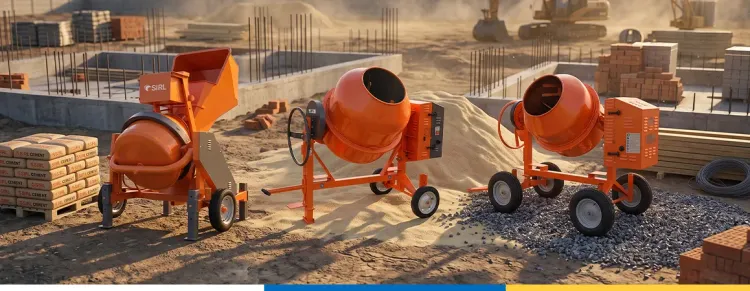
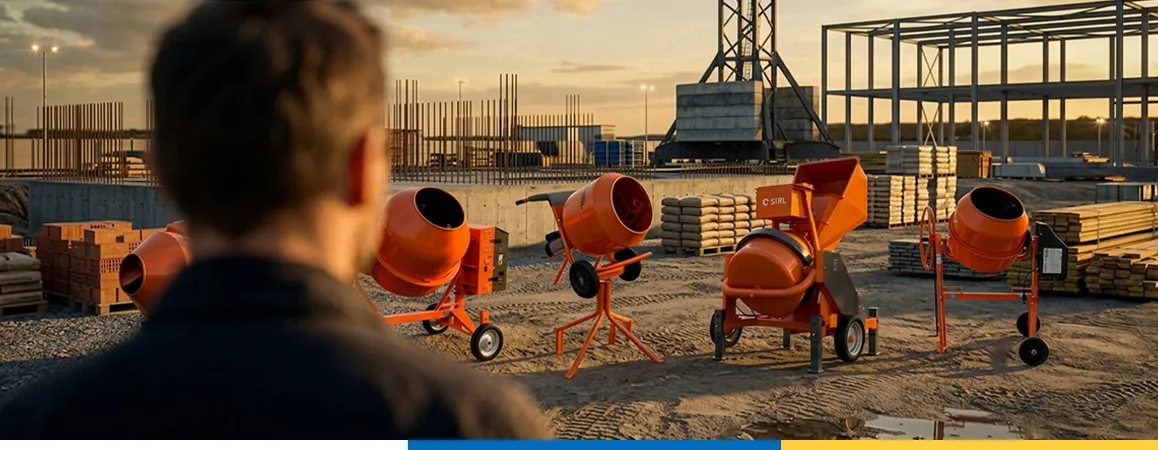
These are SIRL's professional-grade free-fall drum mixers in the 400-litre and 500-litre drum classes. Both share the same engineering DNA: a drum with reinforced opening and three double mixing blades, a lubrification point for low-maintenance operation, a cast-iron gear ring designed for long service life, and a reinforced structure that holds tolerance over years of UAE site abuse.
Each model is available with electric, petrol or diesel motor configurations, letting the buyer match power source to site infrastructure. The drum tilts for fast discharge, and the reinforced frame is rated for towing between casting zones. Full specifications are available on the SIRL product pages on alwisamllc.com/brand/sirl.
BP 400 4R and BP 500 4R, The Towable Configuration
The '4R' variants are configured for projects where the mixer moves frequently. They share the BP-series core mechanics, drum, gear ring, mixing blades, but add four pneumatic wheels, a reinforced pedal mechanism, a fast-tow system, and an approved double tube position for safe towing. On the BP 400 4R, total drum capacity is 360 litres with a maximum mixing capacity of 300 liters and a weight of 210 kg without engine, delivered in a footprint of 1810 × 1100 × 1650 mm.
Compact Options , ECOPRIME 150 and FAST MIX 150
For smaller jobs, repair work, finishing pours, residential extensions, SIRL's ECOPRIME 150 and FAST MIX 150 deliver the same build quality at a 150-litre drum class. These are the right specification for crews that need a portable mixer that can be loaded into a pickup at the end of a shift.
When You Actually Need a Pan Mixer Instead
Drum mixers are the right answer for standard concrete mixes , cement, aggregate, water, and admixtures. They lose efficiency, however, when working with stiff mixes, no-slump concrete, mortars with high fibre content, or refractory mixes that need forced agitation to achieve homogeneity.
For these applications, the SIRL MH 140 pan mixer is the alternative , a forced-action mixer where blades rotate within a stationary pan, producing uniform consistency that a tumbling drum cannot match. UAE flooring contractors specifying epoxy or polymer-modified mixes typically need a pan mixer at some point in their pour sequence.
If you are specifying a concrete mixer this month, the path is:
- Calculate your peak hourly pour requirement (m³/hr) and multiply by 1.4 to set mixer output target.
- Determine which power source is reliably available on-site for the project duration.
- Decide whether the mixer will be static or towable between casting zones.
- For standard concrete: select from the BP 400 or BP 500 series. For stiff mixes or specialty applications: specify a pan mixer.
- Request a quote from Al Wisam Trading the technical team will help you find the right concrete mixer for your project.
GET A QUOTE FROM AL WISAM TRADING Specifying the right SIRL drum mixer for your next UAE pour? Al Wisam Trading technical team responds to enquiries within 24 hours with model recommendations and trade pricing. Contact enquiry@alwisamllc.com or call +971 6 539 03 83. |