











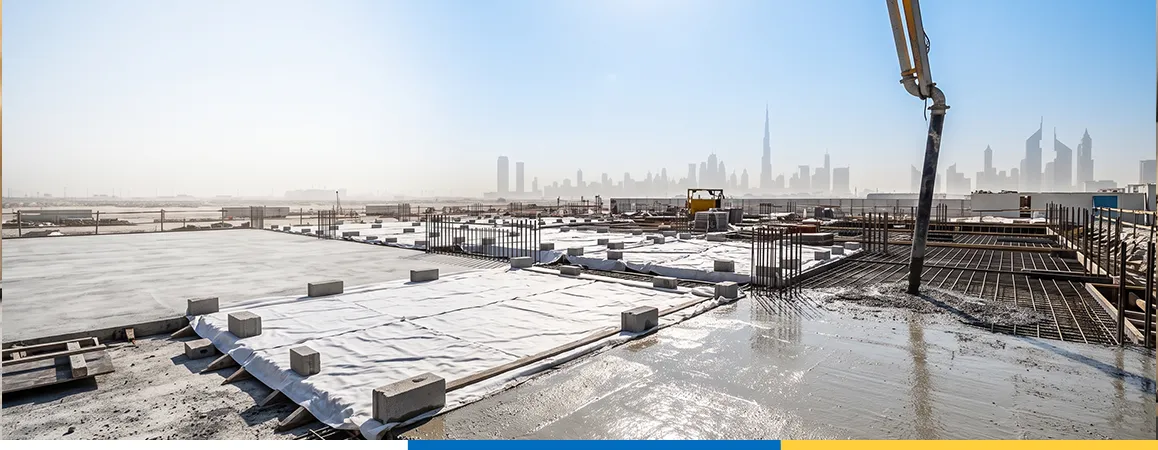
June in Dubai. The temperature hits 43°C by midday. A concrete mix that gave you 60 minutes of workability at 25°C now stiffens in 20. Surface evaporation runs above 1.0 kg per square metre per hour. That is the threshold where plastic shrinkage cracks appear before the concrete even sets. The gap between a quality pour and a problem pour in UAE summer is not equipment, it is preparation.
This guide covers what summer heat does to fresh concrete on UAE sites, how to manage each stage of the pour, and how the right equipment reduces the risk of the most common summer concrete failures.
What Does Heat Do to Fresh Concrete on a UAE Site?
Four things happen to concrete when ambient temperature rises above 32°C, the threshold ACI 305 (Hot Weather Concreting) identifies as requiring active protective measures.
First: cement hydration accelerates. The chemical reaction between cement and water speeds up at elevated temperatures. The mix stiffens faster. The working window, the time between placement and the concrete being too stiff to finish, shortens significantly.
Second: surface evaporation increases. In UAE summer, dry air and high temperature pull moisture from the concrete surface faster than bleed water rises. When evaporation exceeds bleed rate, the surface skin dries and contracts before the body of the concrete has set. This is plastic shrinkage cracking, the fine surface cracks that appear within hours of placement.
Third: water demand increases. The crew adds water at the truck to maintain workability. Every litre of added water increases the water-cement ratio and reduces the final strength of the pour.
Fourth: the finishing window compresses. In temperate conditions, a crew can float and trowel in sequence with minutes between each pass. On a UAE summer afternoon, initial surface set can begin before the first trowel pass is complete. The crew rushes. Finish quality drops.
When Should You Pour Concrete on a UAE Summer Site?
The simplest risk reduction is timing. Pour in the early morning, before 8:00, or after 18:00 in the evening. Ambient temperature, solar radiation, and wind combine to drive maximum evaporation rates in the 12:00–16:00 window. Pours that fall in this window carry the highest risk of plastic shrinkage and rapid stiffening.
Night pours, common on large UAE commercial projects in summer, require tower lights to maintain safe working conditions. Al Wisam supplies DEPCO tower lights for UAE site night-shift illumination.
Where pour timing is dictated by the construction program and cannot be moved to night, apply the protective measures below to reduce the risk.
How Do You Prevent Plastic Shrinkage Cracks on a UAE Summer Pour?
Three measures reduce plastic shrinkage risk.
1. Pre-wet sub-grade and formwork before the pour. Dry concrete and dry ground pull moisture from the bottom face of the slab. Pre-wetting reduces this absorption and slows the rate at which the mix loses moisture from below.
2. Use evaporation retarder on the surface. Apply an evaporation retarder spray immediately after floating, before the surface closes. The retarder slows the moisture loss rate from the top face. Do not use it as a substitute for curing compound after set.
3. Begin wet curing immediately after the surface accepts the curing compound. Do not allow the slab to dry between finishing and curing. UAE summer winds and direct sun can dry an unprotected surface in under 15 minutes after trowelling.
Why Does Vibration Timing Matter More in UAE Summer?
In temperate conditions, you have a generous vibration window, 45 to 90 minutes after placement before initial set makes the needle ineffective. In UAE summer, that window can be 20 minutes or less on an afternoon pour. The poker must go into the concrete immediately after placement in each zone. Waiting, even five minutes in a section, risks trying to vibrate concrete that has already begun to set around the rebar.
A set concrete surface does not accept the poker. The needle cannot penetrate to full depth. The vibration does not reach the reinforcement zone. The result is honeycombing around the bars, a structural defect.
To vibrate correctly on a summer pour, the poker team must stay directly behind the concrete placement team. The moment concrete falls from the chute into a zone, the poker goes in within the next two minutes.
▶ SIRL H 38 (Ø38mm, 6.0m shaft), for tight rebar sections and thin members
▶ SIRL H 45 (Ø45mm, 6.0m shaft), for standard structural work, the all-round choice
▶ SIRL H 60 (Ø60mm, 6.0m shaft), for mass concrete, raft slabs, retaining walls
▶ SIRL SVG100 (petrol, 3.2 kW / 4.3 HP, 24 kg), or SVD100 (diesel, 3.5 kW / 4.8 HP, 26 kg)
Insert at 40–50cm centers for the H 45. Withdraw at 80–100mm per second, slow and steady. Do not touch rebar with the needle. Move before the surface in that zone begins to stiffen.
How Does Your Concrete Mixer Affect Pour Quality in Summer?
A slow mixer extends the time between batching and placement. In summer, every extra minute the mix spends in transit or waiting adds heat and reduces workability. A mixer that cannot keep up with the placing team creates idle time at the pour face, and idle time on a summer pour is a risk.
Match the mixer's production rate to the placing team's output. A team placing and vibrating concrete across a large slab needs a mixer that delivers batches without gaps.
▶ SIRL BP 400 N EVO, 360L drum, 330L mixing, 2.6 m³/hr, diesel, 186 kg
Right for villa foundations, smaller commercial slabs, and sites where the daily pour volume is below 12–15 m³. At 2.6 m³/hr, the BP 400 N EVO is marginal on high-output pour days. Running it at its limit in summer heat adds thermal stress to the machine and reduces the buffer between batches.
▶ SIRL BP 500 N EVO, 460L drum, 430L mixing, 3.3 m³/hr, diesel, 305 kg
The correct specification for sites pouring above 15 m³ per day. At 3.3 m³/hr, the BP 500 N EVO runs at approximately 80% of rated capacity on a day requiring 2.7 m³/hr net output, leaving thermal and production headroom for the afternoon temperature peak. The same engine family as the BP 400 N EVO; a larger drum and a higher output rate.
▶ SIRL BP 500 4R, Towable 460L drum mixer
For sites with multiple pour locations across a large floor area. The towable 4R variant follows the pour, reducing the distance between mixer and placement point. Shorter transport means the mix arrives fresher. In summer, every minute of transport time matters.
Is Sub-Grade Preparation More Important in Summer?
A poorly compacted sub-grade fails after the concrete sets, through differential settlement, void formation, or water movement under the slab. This is a defect that the summer concrete programme makes worse, not better. Once a slab has cracked from sub-grade failure in UAE summer, thermal cycling expands the crack further. The repair is a full slab break-out and relay.
Compact the sub-grade to specification before the pour. The compaction test must pass before any concrete goes down. In UAE summer, once the concrete is placed, there is no correcting what is below it.
▶ Batmatic FP1136 / FP1650 / FP2150, forward plate compactors for granular sub-base
Granular sub-base compaction before slab pours. The FP series handles open sub-base areas with forward-motion coverage. Petrol or diesel engine options.
▶ Batmatic CR3050 / CR4550 / CR5570 / CR9075, reversible plate compactors for deep compaction
For deeper sub-base layers, cohesive infill zones, and confined areas alongside existing structures. The reversible CR series compacts in both directions and achieves greater depth penetration than forward plates.
▶ Batmatic CV70H / CV80Y, tamping rammers for tight access
For sub-base compaction in confined areas beside existing footings, service penetrations, and column starters where plate compactors cannot enter. The rammer ensures the ground directly adjacent to the structure is compacted before the slab pour begins.
Summer Pour Checklist, 10 Steps Before Every UAE Concrete Pour in June to September
1. Schedule the pour for early morning or evening. Avoid 12:00–16:00.
2. Pre-wet the sub-grade and formwork immediately before the pour.
3. Confirm the vibrator team is ready before the first truck arrives. The needle must go in within two minutes of placement.
4. Confirm needle sizes are matched to the reinforcement layout. H38 for tight bars, H45 for standard sections, H60 for mass concrete.
5. Confirm the concrete mixer output rate matches the placing team. If the rate exceeds the BP 400 N EVO's 2.6 m³/hr, use the BP 500 N EVO.
6. Have evaporation retarder available for surface application after floating.
7. Have curing compound and/or wet curing materials on site and ready to deploy immediately after finishing.
8. Station a supervisor at the pour face to monitor surface appearance. Plastic shrinkage cracks visible within 20–30 minutes of placement mean evaporation rate exceeds bleed rate, stop the pour if possible, or apply retarder immediately.
9. Do not add water at the truck to improve workability. Reject any load that has lost workability in transit. Adding water reduces final strength and increases shrinkage.
10. Check the compaction test result before any concrete goes down. A failed compaction test is a slab failure waiting to happen.