











Core Drilling Machine UAE: Complete Buyer's Guide for Contractors in 2026
Author Note: This guide is written by the equipment team at Al Wisam Trading Co. LLC, a Sharjah-based industrial and construction equipment supplier with years of experience helping UAE contractors select the right core drilling machines and diamond core bits for their specific site requirements. We stock and supply Husqvarna core drilling equipment, widely recognised as an industry benchmark for performance and durability.
Core drilling is one of those tasks that looks deceptively simple from the outside, you drill a round hole through concrete. But any contractor who has bought the wrong machine, used the wrong bit for the material, or underestimated what reinforced concrete does to an unprepared diamond segment knows that the details matter enormously.
In the UAE's construction environment, where high-density reinforced concrete is standard, summer temperatures push ambient heat well above 40°C, and project timelines leave little room for equipment failure, getting your core drilling setup right from the start is a practical business decision, not just a technical preference.
This guide covers everything a UAE contractor needs to know before purchasing a core drilling machine: how the machines work, the difference between wet and dry drilling, how to choose the right diamond core bits, what specifications matter in UAE site conditions, and the questions to ask any supplier before you commit.
What Is a Core Drilling Machine and How Does It Work?
A core drilling machine, also called a core cutter or diamond core drill, creates precise cylindrical holes through concrete, masonry, brick, stone, and other hard materials. Unlike impact drilling, which breaks material apart through percussion, core drilling uses a rotating hollow diamond-tipped bit that cuts a ring through the material and leaves a clean-edged cylindrical hole.
The hollow bit is the key to how it works. As the bit rotates under pressure, the diamond segments on its edge grind through the material. The cylindrical core that is cut out, the 'plug', sits inside the bit and is removed once the cut is complete. What is left behind is a clean, round, structurally sound opening with none of the cracking or surface damage that impact methods cause.
This makes core drilling the right method whenever:
- Precision matters, plumbing, electrical, HVAC, and MEP installations that require specific hole diameters
- Surface integrity matters, drilling through finished floors, facade elements, or areas where the surrounding material must not be damaged
- Structural work is involved, creating openings for anchors, posts, or chemical fixing systems in reinforced concrete
- Testing is required, extracting concrete cores for compressive strength testing or material investigation
On UAE construction sites, core drilling is used daily across residential, commercial, and infrastructure projects, from drilling holes for AC duct penetrations and water supply lines to creating anchor points in foundations and extracting test samples from completed slabs.
Wet vs Dry Core Drilling: What UAE Contractors Need to Know
One of the first decisions when selecting a core drilling setup is whether you need wet drilling capability, dry drilling, or both. This is not just a technical preference, in the UAE's operating environment, it is a site safety and equipment longevity question.
Wet Core Drilling
Wet drilling uses a continuous flow of water through the machine to the drill bit during the cut. The water serves three critical functions: it cools the diamond segments to prevent them from overheating and glazing, it flushes concrete debris and slurry out of the hole to keep the cut clean, and it suppresses silica dust, one of the most significant occupational health hazards on construction sites.
- Required for: reinforced concrete, thick slabs (over 150mm), continuous high-volume drilling
- Essential in UAE conditions: ambient temperatures above 40°C dramatically accelerate bit overheating, wet drilling is especially important during summer site work
- Slurry management required: wet drilling produces a water and concrete dust mixture (slurry) that must be contained and disposed of properly, UAE municipalities have regulations around drainage contamination
- Professional requirement: in MEP and structural applications on regulated UAE projects, wet drilling is typically the specified method
Dry Core Drilling
Dry drilling uses no water, the bit cuts without coolant. It is used in specific situations where water cannot be present: electrical work near live systems, overhead drilling where water runoff is a problem, or lightweight masonry and brick work where the material generates minimal heat.
- Suitable for: brick, block, lightweight masonry, isolated overhead applications
- Not recommended for: reinforced concrete, thick slabs, or continuous production drilling in UAE summer conditions
- Dust extraction essential: dry drilling without proper dust extraction creates serious silica dust exposure, a respiratory health hazard that UAE site safety regulations address directly
Al Wisam Practical Note: For most UAE construction contractors working on concrete structures, a wet-capable core drilling machine is the correct choice. The investment in water supply setup and slurry management is offset by significantly longer diamond bit life and consistent cut quality across full working days.
Diamond Core Bits: Choosing the Right Segment for UAE Materials
The machine drills the hole. The diamond bit does the cutting. And in the UAE's reinforced concrete environment, getting the bit specification right is as important as choosing the right machine.
Diamond core bits consist of a steel tube with diamond-embedded segments welded to the cutting end. The diamonds do the grinding work, as they cut through material, the bond holding them gradually wears away, exposing fresh diamond particles. The bond hardness is the most important specification: it determines how quickly the bond wears relative to the material being cut.
Soft Bond Bits
Soft bond bits are designed for hard, abrasive materials. In hard concrete, the abrasive material wears away the bond quickly, exposing fresh diamonds at the right rate. Counterintuitively, using a soft bond bit in soft material causes the bond to wear too fast, wasting diamonds before they can do useful cutting work.
- Best for: hard concrete, heavily reinforced slabs, granite, hard stone
- Common UAE application: cutting through post-tensioned or high-strength structural concrete in commercial and infrastructure projects
Hard Bond Bits
Hard bond bits are for soft, less abrasive materials. The material does not wear the bond quickly, so the diamonds stay in service longer before the next layer is exposed. In hard concrete, a hard bond bit would glaze, the diamonds become buried, and the bit stops cutting effectively.
- Best for: soft concrete, brick, masonry, limestone, soft stone
- Common UAE application: drilling through older, lower-grade concrete in renovation and fit-out work
Reinforced Concrete Bits
Reinforced concrete presents a specific challenge: the bit must cut through both concrete and embedded steel rebar. Specialist reinforced concrete bits use segment designs and diamond concentrations optimised for this transition, maintaining cutting performance as the bit moves from concrete to rebar and back.
- Best for: standard UAE construction concrete with conventional rebar layouts
- Important: when drilling through high-density reinforcement, even specialist bits require correct water cooling and controlled feed pressure to avoid overheating at the rebar interface
Practical tip: Always check the rebar layout before drilling where possible. A rebar scanner used before coring in reinforced slabs is standard practice on professional UAE sites, it helps position holes to minimise rebar interference and extends diamond bit life significantly.
Machine Types: Which Core Drilling Machine Fits Your Work?
Core drilling machines are available in several configurations. The right choice depends on hole diameter requirements, working position, power availability, and production volume.
Electric Rig-Mounted Core Drilling Machines
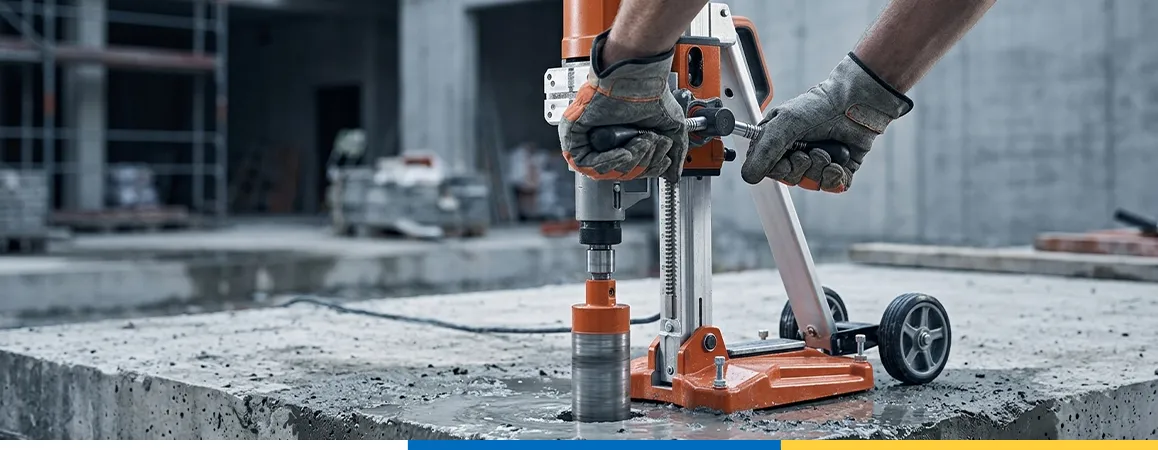
The standard professional setup for UAE construction sites. The drill motor mounts on a drill stand that anchors to the work surface, usually by a vacuum pad on horizontal surfaces or mechanical anchor bolts for wall and overhead work. The stand keeps the machine perfectly perpendicular to the surface, which is essential for accurate holes and prevents bit damage from lateral forces.
- Best for: production coring, large diameter holes (over 50mm), precision MEP work, structural applications
- Typical diameter range: 25mm to 600mm with appropriate bits
- Power: standard 220V single-phase available on most UAE sites
- Husqvarna DM 230 and DM 400 series: widely used on UAE professional sites for their power output and build quality
Handheld Core Drilling Machines
Handheld core drills handle smaller diameter work, typically up to 80mm, where a full rig setup is impractical. They are faster to set up and more versatile in tight spaces, but require a steady hand and correct technique to avoid angled holes that damage bits.
- Best for: small diameter holes, fit-out work, accessible surfaces where rig setup is impractical
- Limitation: not suitable for larger diameters or production-level output, as operator fatigue becomes a quality issue
Hydraulic Core Drilling Machines
Hydraulic core drills use a hydraulic motor powered by a separate power pack. They deliver very high torque output, making them the right choice for the largest diameter holes and the hardest materials, including heavily reinforced structural concrete, where electric motors would stall or overheat.
- Best for: very large diameter holes (300mm+), heavily reinforced concrete, specialist infrastructure work
- Less common on standard UAE construction sites, primarily used by specialist concrete cutting contractors
UAE-Specific Factors That Affect Core Drilling Equipment Decisions
Core drilling in the UAE presents specific challenges that do not always appear in general equipment guides written for cooler climates or less demanding construction environments.
High Ambient Temperature and Motor Loading
UAE construction sites in summer regularly exceed 45°C ambient temperature. Core drilling motors run hot under load. In a European climate this is manageable; in UAE summer conditions, thermal overload protection trips more frequently, reducing productivity and potentially shortening motor life if the machine is not rated for the conditions. Always check the ambient temperature rating of any machine before purchasing for UAE site use.
Concrete Grade and Mix Design
UAE construction standards require high-strength concrete mixes in most structural applications. C30 to C50 grade concrete is common in commercial and high-rise work. Higher-strength concrete is harder and more abrasive to drill. This means softer bond diamond bits wear faster, and machines require more power and torque to maintain drilling speed. Specify your machine's power output and bit grade against the concrete class you will regularly encounter.
Dust and Silica Regulations
UAE occupational health regulations, aligned with international standards, address silica dust exposure on construction sites. Crystalline silica is present in concrete, and fine dust from dry core drilling creates a genuine health risk. On regulated projects, dust extraction or wet drilling is a compliance requirement, not just best practice. Factor this into your equipment selection from the outset.
Power Supply Reliability
Voltage fluctuations on active UAE construction sites can affect motor performance and longevity. Look for machines with built-in overload protection and consider whether a voltage stabiliser is appropriate for the site conditions where the equipment will be used.
What to Check Before Buying a Core Drilling Machine in UAE
Whether you are purchasing your first core drilling machine or upgrading an existing setup, these are the questions that separate a sound equipment investment from an expensive mistake.
- What diameter range do you need? A machine optimised for 50–200mm holes is different from one built for 300mm+ structural work, do not over-specify or under-specify
- Will you primarily be drilling reinforced concrete? If yes, confirm the machine's motor output and bit compatibility for rebar-embedded concrete
- Is wet drilling capability required? For most professional UAE applications, the answer is yes, confirm the machine's water supply system and slurry management needs
- What power source is available on your sites? Confirm single-phase vs three-phase availability; not all UAE construction sites have three-phase supply at every work point
- Are genuine spare parts available locally? A machine that requires parts to be imported on a 3-4 week lead time is a significant operational risk on time-sensitive UAE projects
- Is after-sales technical support available? Core drilling machines require periodic maintenance, motors, gear assemblies, and water feed systems all need servicing, and local technical support matters
Husqvarna Core Drilling Machines, Why UAE Contractors Trust the Brand
Al Wisam supplies Husqvarna core drilling machines, a brand that has earned a strong reputation on professional construction sites across the UAE and the broader Gulf region. The reasons are practical rather than brand loyalty.
Husqvarna machines are built to operate in demanding conditions, high ambient temperatures, dusty environments, and the heavy-duty production pace that UAE infrastructure and commercial projects demand. Their motors are rated for sustained use, their water feed systems are well-designed for wet drilling, and the drill stand systems provide the rigidity needed for accurate cuts in hard reinforced concrete.
- Husqvarna DM 230: the benchmark electric core drill for professional site use, handles 20–230mm diameters, suitable for the majority of UAE MEP and structural coring applications
- Husqvarna DM 400: higher-power output for larger diameter work and denser concrete grades common in UAE commercial and infrastructure projects
- Husqvarna drill stands: DS 250 and DS 500 series, designed for stability and accurate perpendicular alignment, critical for professional hole quality on finished surfaces
Al Wisam stocks Husqvarna core drilling equipment alongside genuine Husqvarna diamond core bits in multiple segment specifications, so contractors can source machine and consumables from a single supplier with local technical support and genuine parts availability.
Buy Once, Buy Right, Core Drilling Equipment Is a Long-Term Investment
A core drilling machine that is properly specified for the work you actually do, the concrete grades, the hole diameters, and the site conditions will deliver reliable performance for years. One that is underspecified will struggle, wear faster, and ultimately cost more through downtime, bit consumption, and early replacement.
In the UAE's active construction market, where project timelines are tight and equipment downtime is a direct cost, getting the specification right upfront is straightforward business sense. The decisions are not complicated once you know what questions to ask, and having a supplier who will help you answer those questions honestly before you purchase is worth as much as the equipment itself.
At Al Wisam, we help contractors across Sharjah, Dubai, and the broader UAE select the right core drilling machine and diamond core bit combination for their specific application, and we back every sale with genuine spare parts from local stock and trained technical support.
📞 Need help selecting the right core drilling machine for your UAE project? Contact Al Wisam Today → https://alwisamllc.com/contact-us