











Battipav Prime 700 and Expert 700: The Building Sector Saws UAE Masonry Contractors Rely On
Most content about Battipav focuses on tile cutting for fit-out projects. That is one part of the Battipav range. The Prime 700 and Expert 700 serve a completely different market. These are building sector saws for masonry contractors, infrastructure crews, landscape teams, and civils subcontractors cutting concrete blocks, curbstones, bricks, and natural stone.
The target buyer is not a tiler. It is a block-laying crew who needs to cut 200mm concrete blocks cleanly all day. It is a curbstone gang on a UAE road project. It is a landscape contractor cutting natural stone paving. These are different applications with different production demands, and Battipav engineers these machines for exactly that use.
What Is the Battipav Prime 700 Used For?
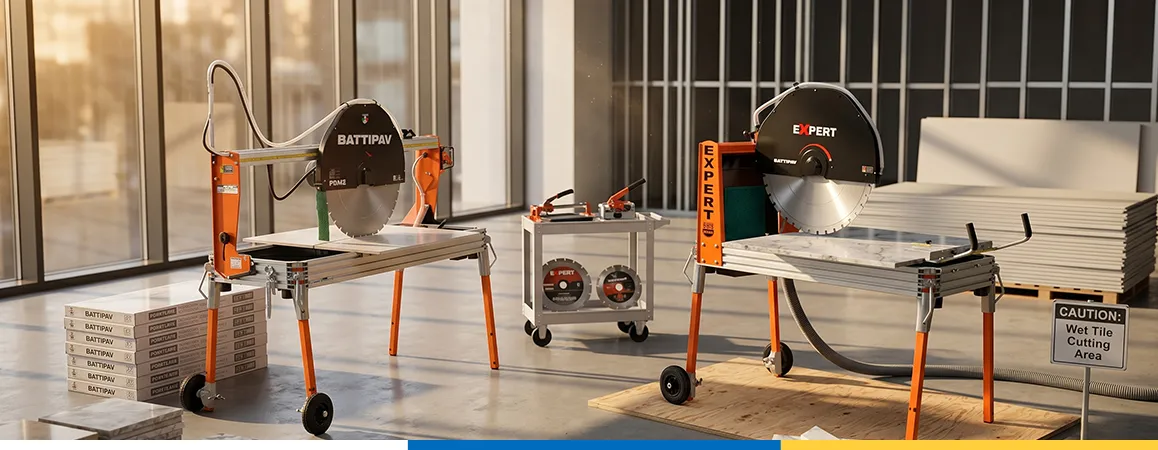
The Prime 700 is a bridge saw for the building sector. Battipav describes it directly: 'suitable for straight and 45° angle cuts of curbs, bricks, poroton blocks, marble blocks and all the different kinds of materials for the building sector.'
This is not a tile saw. The Prime 700 cuts the full range of masonry and building materials that a mixed civils and finishing crew encounters, from standard concrete blocks and curbstones through to natural stone paving and marble boundary details.
The bridge saw design matters for masonry work. The cutting head moves along a precision rail on a fixed table. The material does not move during the cut. This is critical for large or heavy pieces, a concrete block weighing 20 kg cannot be pushed through a fixed blade safely or accurately. The Prime 700 moves the head to the material.
The machine folds for site transport. A masonry crew moving between compounds or road sections can load it into a vehicle and deploy it at the next location without dismantling a complex setup. The Prime 120 and Prime 150 are shorter-rail variants for more compact material formats.
What Materials Can the Prime 700 Cut?
The Prime 700 handles every material that a UAE masonry and civils crew encounters in standard site work.
◆ curbstones, standard concrete curbs for UAE road and pavement projects. Water-fed blade produces a clean cut face with no edge chipping on precast concrete.
◆ Concrete blocks, including standard 200mm hollow blocks, solid blocks, and high-density blocks for structural walls.
◆ Bricks, fired clay and calcium silicate bricks. The water cooling prevents heat cracking on brittle clay units.
◆ Poroton blocks, lightweight thermal insulation blocks increasingly used in UAE residential construction. The Prime 700 produces clean cuts without the block crumbling.
◆ Natural stone, paving slabs, granite boundary details, landscape stone, and sandstone cladding elements. The blade specification changes for natural stone (use Battipav TNSP blade for hard stone).
◆ Marble blocks, for architectural boundary and detail work where marble elements are cut to dimension on site.
What Is the Battipav Expert 700 and When Do You Need It?
The Expert 700 is a production block saw built for volume masonry cutting. Where the Prime 700 is a precision bridge saw that handles mixed materials, the Expert 700 is designed for high-throughput cutting of a single material type, concrete blocks, curbstones, paving bricks, and refractory units.
The Expert 700 has a reinforced steel frame built for daily site use. The high-flow water cooling system manages blade heat across continuous production cutting. The cutting head produces consistent dimensional tolerance across thousands of cuts per day.
On a UAE residential compound construction project, a masonry crew might cut 400–600 blocks in a production day. The Expert 700 is fast enough to keep ahead of the laying team. The block layers never wait for cut supply.
On a UAE road infrastructure project cutting curbstones to gradient and radius, the Expert 700 delivers the cut accuracy that tight kerb-line geometry requires across a long kerbing run.
Prime 700 vs Expert 700, Which One Does Your UAE Site Need?
Choose the Prime 700 when your site cuts mixed materials, different block types, some stone, some marble, varying formats. The bridge saw design and the adjustable head suit precision work on varied materials. Also choose the Prime 700 when the crew moves between sites regularly and needs a machine that folds and loads easily.
Choose the Expert 700 when your primary task is high-volume production cutting of a consistent material, concrete blocks or curbstones, where cut rate determines crew output. One Expert 700 can supply multiple laying operatives simultaneously. The cut rate is faster on repetitive work than the Prime 700.
Some UAE sites need both. The Expert 700 handles the production block cutting. The Prime 700 handles the detail and finishing cuts where exact geometry matters.
Which Diamond Blade Do You Use for Masonry and curbstone Cutting?
The Battipav TNSB blade is the correct specification for block, masonry, and concrete curbstone cutting. The TNSB bond is designed for these abrasive materials. Using the wrong bond wears the blade rapidly and produces a rough cut face on curbstones that affects kerb-line finish.
For natural stone and granite elements on the same site, switch to the Battipav TNSP, the wet-cutting blade for hard, dense natural stone. Al Wisam stocks both blades in Sharjah for rapid replacement orders.
Why Does Blade Selection Matter for UAE curbstone Projects?
On a large-scale UAE road kerbing project, where a crew cuts and lays 200–300 curbstones per day, blade life directly affects daily production cost. A TNSB blade used correctly on standard precast concrete curbs lasts significantly longer than a generic blade used on the same material. The saving per blade multiplied across the project duration is measurable.
Getting the blade specification wrong in the other direction, using a hard-bond asphalt or general-purpose blade on curbstone, produces rapid glazing. A glazed blade stops cutting. The operator presses harder. The machine slows. The cut quality drops. The blade needs replacement. The day's productivity drops.
Specify the blade to the material. It is a straightforward decision with a measurable productivity and cost impact on a production site.