











Air Compressor for Construction in the UAE: How to Choose the Right Machine
Every trade that runs pneumatic tools eventually asks the same question: which air compressor actually fits the job? Buy too small and your breaker stutters every few seconds while the tank recovers. Buy too large and you have paid for capacity, fuel and towing weight you never use. This guide walks through how UAE contractors should size and choose a compressor: the numbers that matter, portable versus stationary, diesel versus electric, and the portable diesel models we keep in stock in Sharjah.
What Compressed Air Does on a UAE Site
On construction and maintenance sites across Dubai, Abu Dhabi and the Northern Emirates, compressed air drives concrete breakers and jackhammers, rock drills, sandblasting pots, shotcrete rigs, pneumatic wrenches and blow-down cleaning. Road crews run cut-and-break work from a towable compressor parked at the kerb; blasting and painting contractors treat the compressor as the heart of the whole operation. Because the compressor feeds everything downstream, an undersized unit slows every tool connected to it.
The Numbers That Matter: Free Air Delivery, Pressure and Duty
Free Air Delivery (CFM)
Free air delivery is the volume of air the machine actually delivers, usually quoted in cfm (cubic feet per minute) or litres per second. This is the number to size against, not tank size and not horsepower. Add up the consumption of every tool that will run at the same time, then add a margin of around 25 to 30 percent for hose losses, wear and the UAE summer, when hot intake air carries less oxygen and machines work harder.
Working Pressure (bar)
Most pneumatic construction tools are designed around 6 to 7 bar. Standard site compressors deliver 7 bar; higher-pressure 10 to 12 bar machines exist for specific jobs like deep drilling, fibre-optic cable blowing and some sandblasting setups. Match the pressure rating to the most demanding tool in the kit, because pressure that is too low shows up as weak, slow tools long before anything obviously fails.
A Rule-of-Thumb Tool Table
| Tool | Typical air demand |
| Chipping hammer / small breaker | 30 to 50 cfm |
| Medium concrete breaker | 60 to 90 cfm |
| Rock drill | 90 to 130 cfm |
| Sandblasting (medium nozzle) | 150 to 350 cfm |
| Two breakers working together | 150 to 185 cfm |
These are working ranges, not exact figures; always check the tool plate. The pattern is clear though: one breaker sits comfortably on a 185 cfm machine, two breakers or light blasting push you towards 275 cfm, and serious blasting or multi-tool crews need 375 cfm and above.
Portable (Towable) vs Stationary Compressors
Portable Diesel Compressors
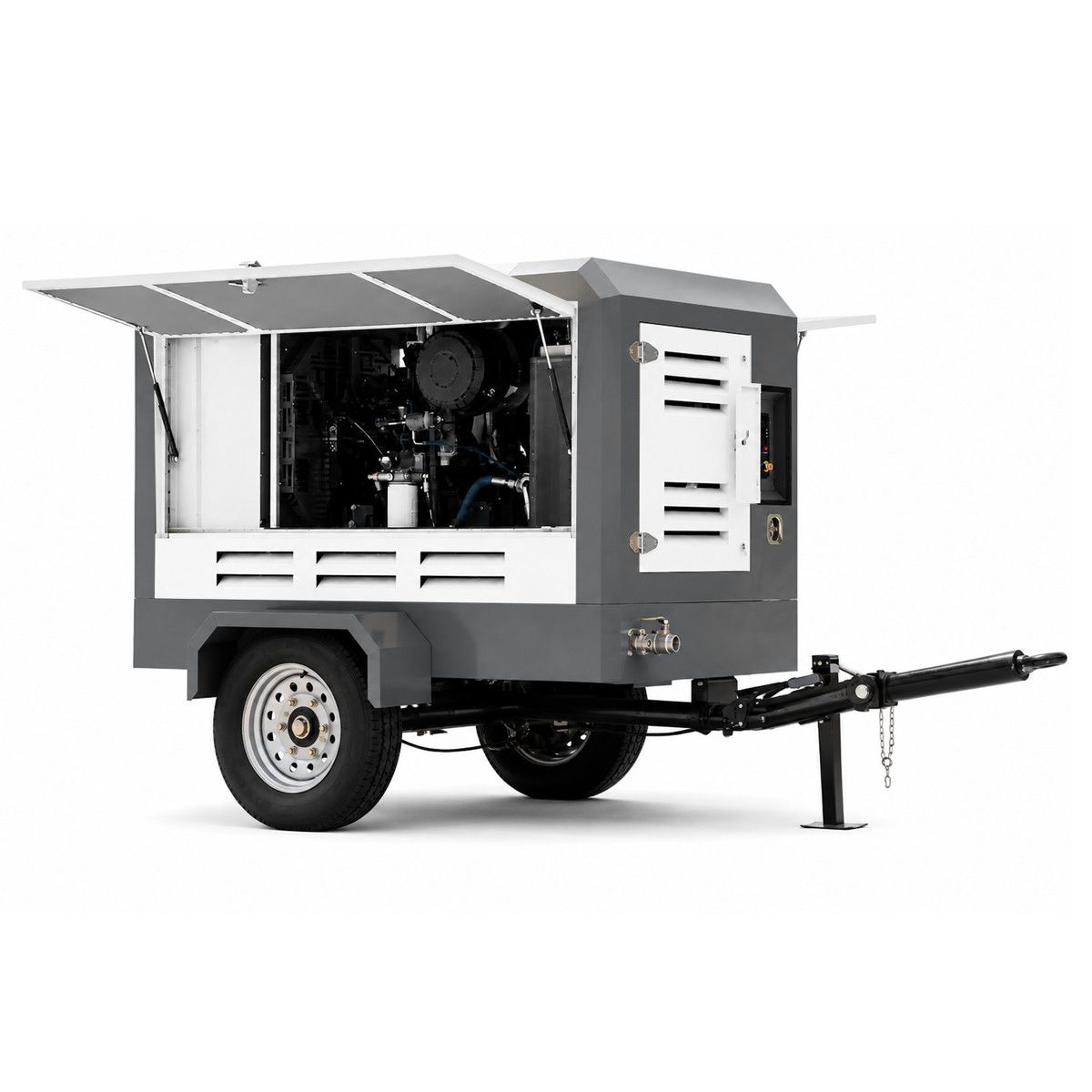
The towable, canopy-covered diesel compressor is the standard UAE site machine. It moves between projects behind a pickup, needs no site power, and its enclosure keeps noise and dust in check. For contractors whose work moves, roads, utilities, demolition, blasting, portability is not a luxury but the whole point.
Stationary / Workshop Compressors
Fixed electric compressors belong where the work stays put: workshops, precast yards, tyre shops and production lines. They cost less to run per delivered cfm and maintenance is simpler, but they depend on reliable electrical supply and they never leave the building. If your air demand lives in one room, stationary wins; if it lives on site, towable diesel wins.
Diesel vs Electric on Site
Diesel drives nearly every site compressor in the UAE for one reason: independence from site power. Temporary electrical supplies are rarely sized for a compressor's motor on top of everything else, and rented sites often have no supply at all. Electric machines win indoors, where exhaust is unacceptable, and in fixed installations. In summer, remember that both types derate in extreme heat; a machine specified with headroom keeps its performance in August, when an exactly-sized one starts falling behind.
The Portable Compressors We Stock
Al Wisam Trading stocks DEPCO portable diesel compressors in the three sizes that cover most UAE site work, plus the MAC3 MSP5000:
- DEPCO DAC-185-7: 185 cfm at 7 bar. The single-breaker workhorse for road repair, light demolition and general pneumatic tools.
- DEPCO DAC-275-7: 275 cfm at 7 bar. Runs two breakers or a medium blasting setup without strain.
- DEPCO DAC-375-10: 375 cfm at 10 bar. The high-output, high-pressure choice for blasting contractors and multi-tool crews.
- MAC3 MSP5000: a compact portable diesel unit for lighter continuous duty.
Full technical PDFs are on each product's datasheet page, and the complete range is on the portable compressors category.
What to Check Before You Buy in the UAE
Cooling and Summer Derating
A compressor that tests fine in March must still deliver in August. Look for cooling systems and service intervals specified for high ambient temperatures, and size with margin rather than to the exact tool demand.
Dust and Filtration
UAE sites are dusty by default. Easily serviced intake filters and a canopy that seals well protect the airend, which is the expensive heart of the machine.
After-Sales and Spare Parts
A compressor is a long-service asset; filters, separators and consumables decide its uptime. Buy from a supplier who stocks parts locally. Al Wisam Trading backs the DEPCO range with spares and service from our Sharjah base.
Towing and Site Compliance
Check the running weight against what your vehicles can legally tow, and confirm lighting boards and coupling types before the machine needs to cross the city between sites.
Frequently Asked Questions
What size air compressor do I need for one concrete breaker?
A medium breaker typically consumes 60 to 90 cfm at 6 to 7 bar, so a 185 cfm portable compressor such as the DEPCO DAC-185-7 runs one breaker with comfortable headroom for hose losses and summer heat. Always confirm the figure on the breaker's own data plate.
How many CFM do I need for sandblasting in the UAE?
Blasting is the hungriest common application: a medium nozzle draws roughly 150 to 350 cfm depending on nozzle size and pressure. Most blasting contractors here run 375 cfm class machines like the DAC-375-10 so the nozzle pressure never sags mid-job.
Is a bigger tank better than more CFM?
No. A tank only buffers air; it does not create it. Continuous tools like breakers and blasting pots drain any tank in seconds, so free air delivery (cfm) is the number that decides whether tools keep working. Size on delivery first and treat tank volume as secondary.
Diesel or electric compressor for site work?
For open construction sites in the UAE, diesel: it needs no site power, tows between jobs and handles breakers and blasting. Electric suits workshops and indoor work where exhaust is unacceptable and supply is reliable.
Do compressors lose performance in UAE summer heat?
Yes. Hot intake air is less dense and engines derate at high ambient temperatures, so a machine sized exactly to tool demand in winter can fall short in August. Specify roughly 25 to 30 percent of headroom and keep filters clean through the dusty months.
Does Al Wisam provide spare parts and service for compressors?
Yes. We stock filters, separators and service parts for the DEPCO compressor range at our Sharjah warehouse, with technical support and delivery across Dubai, Abu Dhabi and the Northern Emirates.
Wrapping Up
Choosing an air compressor in the UAE comes down to three decisions: total cfm with summer headroom, the pressure your most demanding tool needs, and diesel portability versus electric economy. Match those honestly to your work and the machine pays for itself; guess, and it becomes the bottleneck of every job. If you want a second opinion on sizing, send your tool list through a quotation request and our team will recommend the right machine from stock.